Off-grid house on Sal, Cape Verde
English | Deutsch | Nederlands | Français | Español | Italiano | Português
An off-grid house on Sal (Cape Verde, Cabo Verde) produces its own electricity, stores it in a battery and manages its own water. It is the way to live on a quiet plot near Murdeira or outside Santa Maria and Espargos, without waiting for a grid connection and without power cuts.
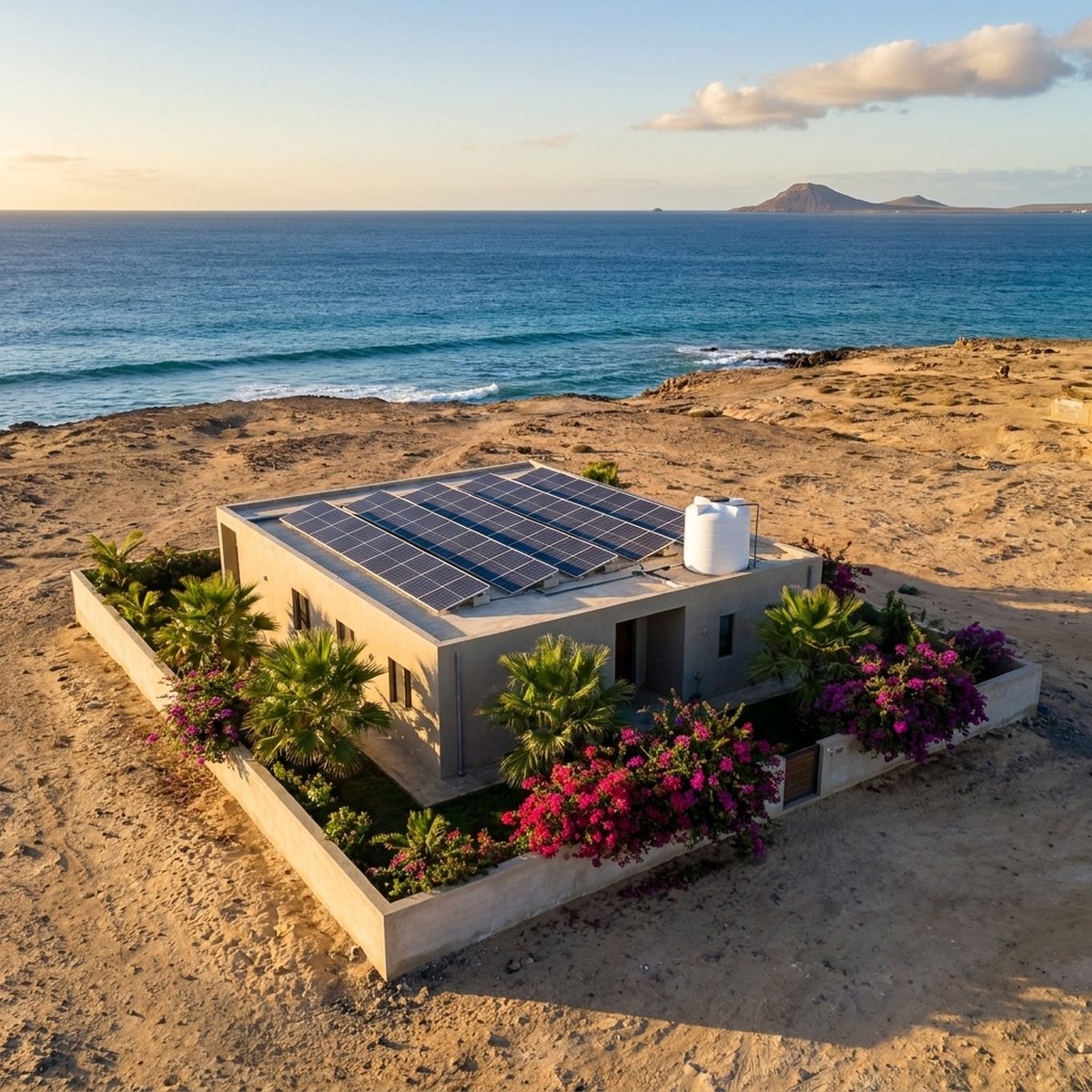
Start with the house, not with the panels
The cheapest kilowatt hour is the one you do not need. On Sal that starts with the design: thick, light coloured walls, shade on the south and west side, cross ventilation that uses the trade wind, and efficient air conditioning only where it is really needed. A well designed house needs a much smaller solar system and battery.
Energy: solar, battery and a backup
- Solar panels on the flat roof or on a ground frame, sized for your full daily consumption.
- A lithium battery bank for the evening and night, with a margin for hazy days.
- An off-grid inverter that can handle the starting current of pumps and air conditioning.
- A generator input as a safety net for long periods with less sun.
How large each part should be is explained on sizing an off-grid system.
Water in an off-grid house
Water on Sal is produced by desalination. An off-grid house therefore usually has a large water tank or cistern, and a pressure pump that runs on solar power. Some owners add a small reverse osmosis unit; that uses a lot of energy and must be included in the design. A solar water heater gives hot water without using your battery.
Cooling, cooking and appliances
Choose inverter air conditioners, an efficient fridge and induction cooking with care, and run heavy loads such as the pool pump or the washing machine during the day, directly on solar power. Then the battery stays available for the night.
Buying a plot or house for off-grid living
Not every plot is suitable: orientation, shade, access for maintenance and the distance to the sea all matter. Huefter combines the energy design with your property purchase on Sal, and knows areas such as Murdeira. Back to off-grid solar on Sal, or send us a message on WhatsApp: +238 597 56 78.